
Custom Memory Cards — Printed to Your Artwork, Built to Your Specification
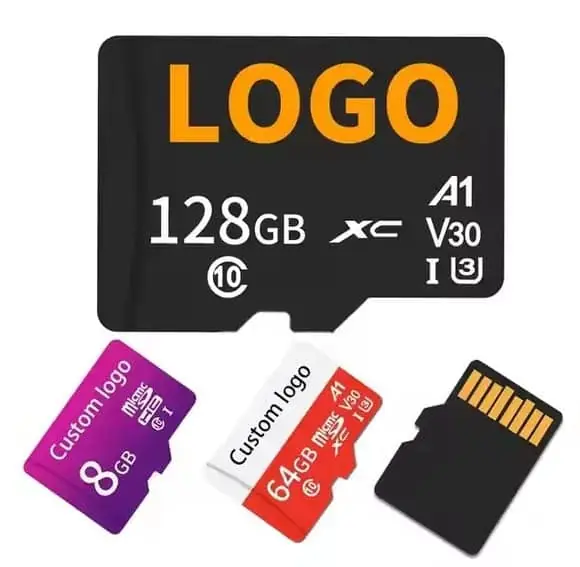
A custom memory card is an OEM or ODM card produced to your own specification: the capacity and speed you need, printed with your artwork, packed the way you want it, with your brand on the product instead of ours. The minimum order is 50 pieces, and the published range is US$2–6 per unit from 500 pieces. OEM means the card is built to your specification and carries only your brand; ODM means you take our existing TF card and apply your artwork. WINTEL prints to buyer artwork as part of production rather than as a separate decoration step, so the flash inside the branded card is specified by you — capacity, grade and read/write speed — instead of being whatever module is in stock.
Custom SD card order facts, in one place
- Minimum order50 pieces — and it does not move with capacity mix or with the number of artworks in the order
- Small batches50 to 500 is a normal order here, not an exception we tolerate
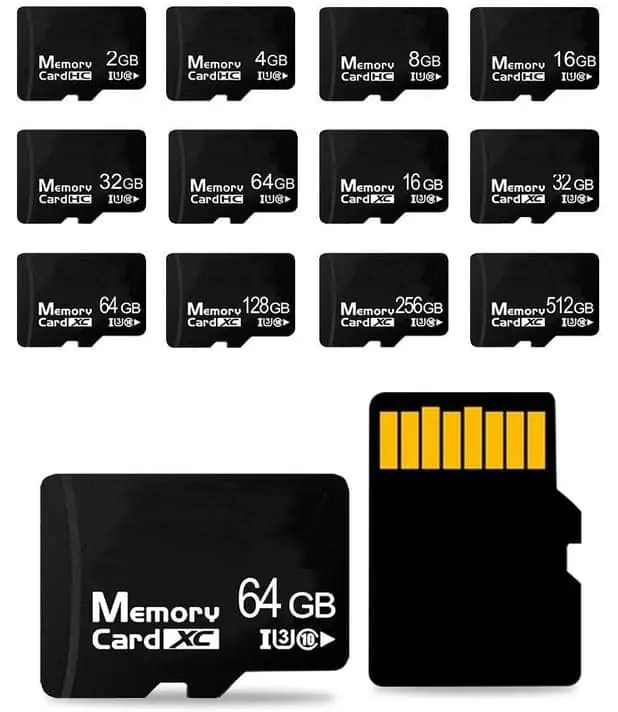
- Capacities4GB to 256GB, in the microSD / TF form factor
- PrintYour artwork on the card face, front and back, printed inside the production run
- PackagingBulk tray, retail blister or printed box — quoted separately, each with its own minimum
- SampleA printed sample is approved before the bulk run
- Where it ships fromOur own line in Shenzhen, China — not a trading desk
- Who answerscathy@go-wintel.com — Cathy, sales engineer
If you are comparing this against a US card printer, the difference is usually the floor rather than the print. A small-batch printer sells in increments small enough to serve a single shop, at a retail markup. A factory starts at 50 pieces and expects you to specify the silicon, the capacity and the print file yourself — which is cheaper per card and more work for you.
What you can change, and what it affects
| Variable | Options | What it affects |
|---|---|---|
| Capacity | 4GB to 256GB | Affects price directly. Does not affect MOQ. |
| Read / write speed | Specified per project against your workload | Affects silicon and controller selection. Confirm before quoting. |
| Card printing | Your logo or artwork, printed to order | Artwork needed before the run. Approve a printed sample first. |
| Packaging | Bulk, retail blister, presentation box | Affects unit cost and lead time. Quote it with the product, not after. |
| Pre-loaded content | Data, documents or media written before packing | Tell us at enquiry stage — it changes the production flow. |
| Product format | TF card, UDP module, finished USB drive, or semi-finished board | If you have your own housing or line, order the module or board instead. |
Which card for which device
The same 32 GB card can be right for one product and wrong for the next, because what ends a card’s life is the workload rather than the capacity. What differs by device class is not the number printed on the front but what the card is asked to do every hour it is powered:
| Device class | What the card has to survive | What belongs in the specification |
|---|---|---|
| Dash and body cameras | Continuous write inside a sealed, sun-loaded enclosure, with no long idle period to recover | Sustained write for the recording bitrate rather than the burst figure; endurance grade; a test at the temperature the housing actually reaches |
| Access control and kiosk terminals | Read-mostly traffic, long idle periods, and power that is cut without warning | Behaviour on power loss, the file system the host expects, and a small capacity chosen deliberately rather than by default |
| Education tablets and e-readers | Read-mostly, many identical units, replacement stock ordered years later | SDHC below 32 GB or SDXC above it, and the file system that follows from that boundary |
| Medical and dental imaging | Bursts of large files, a fixed set of host firmware, and a host that may refuse a card it was not validated against | The largest capacity the host will mount, the file system it needs, and a written acceptance test per lot |
| IoT and data logging | Small sequential appends, forever, on a device nobody visits | Endurance and the controller’s allocation behaviour, because the write pattern never lets up |
| Audio, video and drone recorders | A sustained bitrate that must not stall mid-recording | The speed class the bitrate requires, and the bus mode the host can actually negotiate |
Each of these is covered in its own piece: dashcam cards, access control terminals, tablets and e-readers, medical and dental imaging, IoT logging and speed class against bus interface.
The capacity bands, and what to write in the specification for each
Capacity is the first thing named on an enquiry and the last thing worth choosing first. Read this table down the left column, then across: the right-hand column is the mistake that actually gets made in that band.
| Capacity | Speed class and app performance | What this band is normally ordered for | The trap at this band |
|---|---|---|---|
| 4GB / 8GB | Class 10; app performance rarely specified | Legacy terminals, audio players, firmware-load cards, small promotional runs | Small-capacity die is the first to be discontinued. A repeat order a year later may come back at a different price or a different capacity. |
| 16GB | Class 10 or U1 | Giveaway cards, e-readers, entry-level dashcams | It is assumed to be the "safe" middle. In practice it is where silicon grade varies most between quotes for the same headline price. |
| 32GB | U1 or Class 10; A1 if the host runs apps | Dashcams, POS terminals, school tablets, small IP cameras | This is the band where the visible-capacity argument happens — a 32GB card reports about 29.8GB, and that has to be answered before the first complaint. |
| 64GB | U3 / V30; A1 or A2 | Continuous recording, 1080p dashcams, drones, body cameras | A card carrying a U3 mark that only sustains U1 inside a hot, sealed housing. The class is a floor, not a guarantee at temperature. |
| 128GB | U3 / V30; A2 | 4K recording, medical and dental imaging, large log buffers | Sustained write falls away once the write buffer is exhausted. Benchmark figures on an empty card do not describe hour three of a recording. |
| 256GB | U3 / V30; A2 | High-bitrate video, industrial data logging, archive capture | Highest value per batch, so a grade substitution here is the most expensive mistake on this page — and the least visible on arrival. |
Why the class and the bus are separate decisions: speed class against bus interface. Writing the document? There is a TF card specification template with the fields in the order a factory needs them.
How the card itself is built — five stages, and what is checkable
Ordering a card is one process; making one is another. These are the stages on our floor, and the decision each one locks in. If a supplier cannot say which stage a decision belongs to, they are describing a catalogue rather than a factory.
| Stage | What happens | The decision made here | What you can check |
|---|---|---|---|
| 1. Die sorting and grading | Incoming die is screened and graded before it is bonded or packaged. Grade drives retention and failure rate far more than it drives the benchmark number. | Die grade and source | Ask for the sourcing breakdown against your project. |
| 2. Die attach and encapsulation | Bare die is bonded and encapsulated inside the card, or a packaged part is placed. The format is chosen against capacity, cost target and thickness. | Die package format — COB, TSOP, BGA or LGA | Package format stated on the quotation, not inferred from the price. |
| 3. Controller pairing and programming | The controller is paired with the flash and configured to the capacity, the class and the host interface. This is what decides whether the card sustains its marked rate. | Controller solution | Test the sample in the device it is destined for, not in a card reader. |
| 4. Print and surface | Artwork is printed on the card face, front and back, inside the production run rather than applied afterwards. | Print method and ink coverage | A printed sample in your hand before the bulk run — see what makes print adhere to a card face. |
| 5. Test and pack | Full-capacity write and read-back plus a speed check, then bulk tray, blister or printed box. | Acceptance criteria | The test report shipped against the lot code — ask before you need it. |
Schedule: the four stages, and the one you control
Buyers ask for "the lead time" and get one number that hides three others. Split it and you can see where a date is actually recoverable.
| Stage | Typical duration | Who controls it | How it moves |
|---|---|---|---|
| Artwork and approval | 1–7 days | You | Proof rounds and colour conversion. Approving from a screen rather than a printed sample is what adds a round. |
| Production | 3–15 working days | Factory | Card programming, printing and packaging. Stock capacities run at the short end. |
| Testing | 1–5 working days | Factory | Full-capacity write and read-back runs per unit, so it scales with the lot and cannot be compressed away. |
| Transit and clearance | 3–20 days | Neither, entirely | Freight mode, customs and last mile. Plan the buffer instead of arguing about it later. |
Worked through in full, including what each stage consumes: how long a custom microSD order takes.
How a custom card order runs
- Send artwork and specification Capacity, quantity, print requirement, packaging and target date. Tell us the file format you have.
- We confirm what is achievable Which print method suits the card surface, what the artwork needs to be, and what the configuration will be.
- Full quotation Product, printing and packaging priced together, with MOQ, lead time and validity stated.
- Sample approval You approve a printed physical sample before bulk production. This is the only reliable way to confirm the result.
- Production and verification Capacity and read/write verification before packing, then shipment against the agreed schedule.
What the print can and cannot carry
A memory card is a 15 × 11 mm moulded surface with a raised lip and a write-protect notch. That geometry sets hard limits on what artwork survives, and most rejected proofs fail on one of these five points rather than on colour.
Fine detail and hairlines
The card surface is small and the print is applied at production speed. Thin strokes and small type fill in. If the logo only works at large size, it needs a simplified variant for the card — not a smaller copy of the full mark.
Full-bleed colour
Coverage across the whole face is achievable, but colour is laid over a moulded surface rather than paper. Large flat areas show more variation than line artwork does.
Colour matching
Screens are emissive and cards are not. A Pantone reference is a starting point, and the only meaningful approval is a physical print on the actual card surface.
Gradients and photographic images
These are the first things to lose fidelity at this size. Where an image has to appear, expect it to read as texture rather than as a photograph.
Content in the notch and lip areas
The write-protect notch, the contact-side edge and the moulded lip are not print areas. Artwork that runs into them is trimmed, not reproduced.
Back-of-card information
Capacity marking, a batch or lot reference and legal text usually live on the reverse. If your compliance requirement needs a specific statement on the card, say so with the artwork rather than after the proof.
Printing a card is covered in more depth in artwork formats we accept and getting a Pantone colour right on plastic.
What the card reports, and why a 32GB card reads as 29.8
The number printed on a card is decimal. The number a Windows or macOS dialog shows is binary. Nothing has been lost between the two — they count in different units, which is why the host reports GiB while the card is sold in GB. The binary prefixes are defined in IEC 80000-13, and the gap for the capacities we run looks like this:
| Printed on the card | Reported by a binary host | What moves the figure |
|---|---|---|
| 4 GB | ≈ 3.7 GiB | Unit conversion only |
| 8 GB | ≈ 7.4 GiB | Unit conversion only |
| 16 GB | ≈ 14.9 GiB | Unit conversion only |
| 32 GB | ≈ 29.8 GiB | Unit conversion only |
| 64 GB | ≈ 59.6 GiB | Unit conversion only |
| 128 GB | ≈ 119 GiB | Unit conversion only |
| 256 GB | ≈ 238 GiB | Unit conversion only |
Formatting and the controller’s own reserve take a little more on top, which is normal and expected. A card that reports materially less than the row above — a 128 GB card showing 32 GB, say — is a capacity problem rather than a notation one. The test that separates the two is a full write-and-read-back: verifying real capacity walks through it, and why there is no 36 GB card explains the banding. Source for the prefixes: IEC 80000-13:2025.
How a batch is verified before it ships
Capacity and read/write verification happens before packing, and the words are worth pinning down, because “100% tested” and “capacity verified” are not the same claim.
- Capacity is proved by writing, not by reading a file list. A full write-and-read-back fills the whole advertised capacity and compares what comes back. A reader that shows the expected folder proves nothing, because a faked controller answers that question from firmware.
- Speed is measured against your workload. A sequential figure and a small-block random figure are two different measurements. The one that matters is the one your device generates, at the queue depth your device generates it at.
- Sampling follows the plan agreed in the order. Where a contract is silent, the usual default for lot-by-lot inspection is ISO 2859-1 General Inspection Level II. Whichever plan is used, the report should state the sample size, the tool, and the temperature the test ran at.
The reference tool for a write-and-read-back is f3 on macOS and Linux, H2testw on Windows. What to put on a sample before you sign it off is covered in what to check on a flash sample, and the sampling numbers in what a third-party inspector can and cannot sign off.
Where custom orders go wrong — and how to avoid it
- Colour approved on screen, not in hand. Approve a printed physical sample before the run.
- Packaging quoted after acceptance. Ask for product, printing and packaging in one quotation.
- Capacity specified, silicon not. A price without a stated grade is not comparable to another price.
- Content pre-load requested late. Tell us at enquiry stage, not after production starts.
OEM, ODM or plain custom — the three are not the same order
Buyers arrive using all three words for the same thing. On the production floor they describe three different orders, and the one you pick decides whether tooling is quoted, whose model number the card carries, and how long the first batch takes.
| Route | Whose product is it | What you control | What it costs you up front |
|---|---|---|---|
| Custom | Our card, decorated with your artwork. | Print, packaging, capacity, speed. | Set-up for print. No tooling unless the pack is bespoke. |
| ODM | Our card, your brand throughout — product, pack and paperwork. | Everything above, plus the brand that appears on the test record. | Set-up for print and packaging artwork. |
| OEM | Your product, built to your specification. | Silicon grade, controller solution, capacity test criteria, label data, packaging spec. | Specification work, and a sample round before the run is released. |
The line that matters in an OEM enquiry is the test criterion, not the print. If the card has to pass your incoming inspection rather than ours, say so at enquiry stage — it changes the sampling plan and the report that ships with the batch. See how to verify a supplier.
Price ladder: why 50 pieces never costs 50,000 divided by 50,000
Two of the four cost lines are fixed — print set-up and packing tooling — so the per-unit price falls because those fixed costs are spread thinner, not because the flash gets cheaper. Below 500 pieces the set-up dominates and a published figure would be misleading, so we quote it.
| Quantity | Published price | What is included | What changes at this band |
|---|---|---|---|
| 50 – 499 | Quoted per project | Print set-up, artwork proof, sample, bulk pack | Set-up dominates. Ask for set-up and per-unit as separate lines so you can compare two suppliers. |
| 500 – 4,999 | US$2 – 6 / unit | Card, print, capacity test report, bulk or retail pack | Published range applies from here. Position inside the range is set by capacity and speed grade, not by quantity. |
| 5,000 – 49,999 | Lower end of the range | Scheduled releases against one artwork approval | Printing and packing fall per unit; silicon does not. Re-confirm the card grade, because a price that drops too far usually means the grade moved. |
| 50,000 + | Programme pricing | Frame agreement with call-off releases | Priced against the NAND market. Lock the review cadence and the grade, not a single number. |
The card we actually produce
Our TF card line runs one body, because one body is what the volume work needs: a card whose behaviour does not change between batches is worth more to a buyer than a range of shapes. The current specification — dimensions, weight, capacity range, speed class, test method and the order notes — is on the Monitoring microSD card specification page.
Buying for a specific device rather than a specific card? Start from the device: drones, repair shops, wedding photographers, or the TF card product range.
Send your artwork and specification
We reply to business enquiries within 1 business day. If you are not sure which format fits, describe the product and we will advise.
Or email cathy@go-wintel.com — answered by Cathy, sales engineer.
Frequently asked questions
What artwork format do you need?
Tell us what you have and we will confirm. Vector artwork gives the cleanest result for logos. Artwork handling is confirmed per project once we know the print method and the surface.
Can you match our brand colour exactly?
Tell us your colour specification when you enquire. Achievable accuracy depends on the surface and the print method, so we confirm it per project rather than promising a universal match.
What is the minimum order for custom memory cards?
50 pieces. That is the floor for a printed custom card order on a standard card, and it does not move with capacity or with the number of artworks inside the order. Two things are quoted separately because they carry their own minimums: a bespoke mould, if you need a shape that does not exist, and custom retail packaging, which is made by a different process and usually by a different supplier.
Does custom printing raise the MOQ?
No. Printing to your artwork is part of the production run, and the floor stays at 50 pieces whether the run is printed one colour or four. Bespoke tooling — a moulded shape rather than a printed card — is what changes the economics, and it is quoted as a separate one-off line.
How long does a custom order take?
It depends on capacity, print method, packaging and whether tooling is needed. We confirm a schedule in the quotation against your target date rather than publishing one lead time for every order.
Can you pre-load our content onto the cards?
Yes, if you tell us at enquiry stage — it changes the production flow and needs your content before the run starts.
Can I see a sample before ordering in volume?
Yes, and for colour-critical artwork we recommend it. Sample approval is part of the process before bulk production begins.