
Quality Control in Flash Memory Manufacturing
Quality control in flash memory manufacturing happens at three points: when die arrives, during assembly, and before packing. The check that matters most to a buyer is the last one — capacity and read/write verification — because under-capacity cards are the most reported failure in this product category and they are invisible until someone tests. WINTEL runs capacity and read/write verification as part of its own production flow before packing. We publish what we check and the documentation behind it — RoHS compliance and SGS test reports are available on request — and we say plainly when an independent test report or named reference is not yet available.
The three checkpoints that matter
| Checkpoint | What is checked | Why it matters | Evidence we can show |
|---|---|---|---|
| Incoming material | Die is screened and graded before it enters production. | Grade set here determines retention and field failure rate. It cannot be corrected later in the chain. | Company-stated A+ grade sourcing from named manufacturers. |
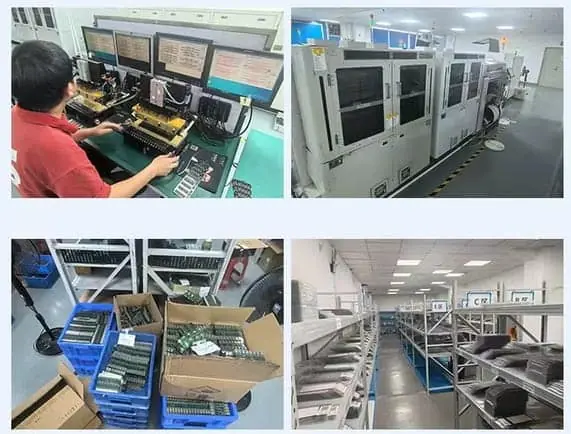
| In-process | Boards and modules are handled as work in progress with visual and functional checks between stages. | A bonding or placement defect caught here does not become a field failure. | Photographed work-in-progress on the production floor. |
| Before packing | Capacity and read/write performance are verified. | This is the last point a bad unit can be caught. It is also the check you can repeat yourself. | Test station and burn-in oven in use, photographed. |
| Packing | Bulk, retail or presentation packing to the approved specification. | Wrong packaging is the most common non-product reason a shipment is rejected. | Confirmed against the approved sample before the run. |
Five tests that are not interchangeable
Buyers often treat one test result as proof of several things at once. It is not. Each test below answers one question, and passing one says nothing about the others. Which tests were run — and on how many units — is part of what you should agree before the order.
| Test | What it proves | What it does not prove | How it is run |
|---|---|---|---|
| Full-capacity write-and-read-back | The unit stores the capacity it claims, end to end — catches overstated or fake capacity. | Speed, endurance, or the grade of silicon inside. | Write the full capacity then read it back and compare; H2testw or F3 on a sample from each batch. |
| Reader recognition | The host detects the drive, mounts it and sees the expected capacity and file system. | That the capacity is real or that data survives a full write. | Plug into a test host and confirm mount, reported capacity and file system before the write test. |
| Sequential speed test | Peak read/write rate on a large contiguous file under the stated test conditions. | Sustained speed after the cache fills, or speed on small files. | CrystalDiskMark or the speed output of the capacity tool; host, file size and port must be stated. |
| Sustained write test | The rate that holds after the cache is exhausted — the number that predicts long writes. | Endurance over the product life, or a guarantee for a different host. | One 4GB+ file, discard the first 20–30 seconds, record the steady rate over at least a minute. |
| Endurance test | How a card holds up under repeated writes or long recording — relevant to dashcam and surveillance. | Peak speed or one-time capacity accuracy. | Defined by the workload in the order; run to the write-volume target agreed with the buyer. |
Capacity and read/write verification run on every unit before packing. Speed, endurance and reader-recognition checks are run as defined by the product specification and the order — we do not publish a generic sample size, because the right figure depends on the product and the acceptance criteria you set. Which test was applied to your batch is stated on the test record.
What a buyer should ask any supplier
- What grade of flash, from which source, on this specific order? A grade in a brochure is not a grade on your batch.
- What happens if that source is unavailable? The answer tells you whether substitutions get disclosed.
- What is tested before packing, and can I see the method? A supplier that will not describe the test probably does not run one.
- Can I approve a sample before the run? If not, colour and finish disputes are decided after your money is spent.
- What certification exists, and may I see the certificate? A logo is cheap. A certificate has a number on it.
These questions work on any supplier, including us. Asking them is how you find out whether a factory description is specific or decorative.
What we document, and what we do not — yet
Documented
- Capacity and read/write verification before packing
- Die grade stated per project, with named sources
- Controller solution and package stated per project
- Sample approval before bulk production
- Business registration record of the contracting entity
Not yet published
- Named customer references and project case studies
- Third-party certifications (ISO / CE / FCC / RoHS) certificate scans
- Independent test reports (capacity, endurance, failure rate)
Published compliance & tests: RoHS, SGS. We add a mark only when we hold the certificate behind it.
Tell us your acceptance criteria
If you work to a defined test standard, send it with your enquiry and we will confirm how the batch is checked against it. We reply to business enquiries within 1 business day.
Or email cathy@go-wintel.com — answered by Cathy, sales engineer.
Frequently asked questions
What do you test on a finished card or module?
Capacity and read/write performance, as part of the production flow before packing. Tell us the acceptance criteria you work to and we will confirm how the batch is checked against them.
Can I verify a batch myself?
Yes, and we recommend it. H2testw writes and reads back the full capacity of a card and reports any discrepancy. The method is published on our memory card testing page and works on any card from any supplier.
Do you have ISO 9001 or similar certification?
We publish only certifications we hold and can show documentation for. The current status is listed on our About page and in the factory facts on the Factory page — where a certificate is not listed, we do not claim it.
Which units are tested individually, and which are sampled?
Capacity and read/write verification run on every unit before packing — that check is per-unit because fake capacity is silent and varies piece by piece. Speed, endurance and reader-recognition checks follow the product specification and the order agreement; we do not quote a generic sample size that would be meaningless across different products. The test record for your batch states which checks were run and on what basis.
What happens to a unit that fails a test?
A unit that fails capacity or read/write verification does not ship as good stock: it is pulled from the batch and reworked or scrapped, and the batch record is kept. We do not quietly pass a failed unit by narrowing the test. If your order has a defined acceptance procedure, send it and we will confirm how failures are classified and reported against it.
What test equipment and software do you use?
Capacity verification is a full write-and-read-back — the same principle a buyer can repeat with H2testw or F3. Speed checks are run with a standard sequential benchmark under stated host, file-size and port conditions. We describe the method rather than claim a brand of software as a certification; the photo on this page shows the test station in use.
What is your failure rate?
We do not publish a failure rate we cannot support with recorded data. If you need a documented figure for your own qualification process, tell us your requirement and we will discuss what we can provide.
Can I approve a sample before bulk production?
Yes, and for colour-critical branding or a bespoke mould it is the only reliable way to confirm the physical result. See how samples work.