
Monitoring microSD Card — C10 and U3 for Dashcams and CCTV
A monitoring microSD card is the same 15 × 11 × 1 mm card as any other. What differs is how it is chosen and tested: for continuous overwrite in a recorder rather than for burst transfer in a camera. We supply C10 and U3 grades from 2GB to 512GB, blank or printed with your artwork, for dashcams, CCTV recorders and card-reading speakers. In most “card keeps failing” cases the recorder’s write pattern is the constraint, not the card. WINTEL supplies this from its own plant in Shenzhen, China.
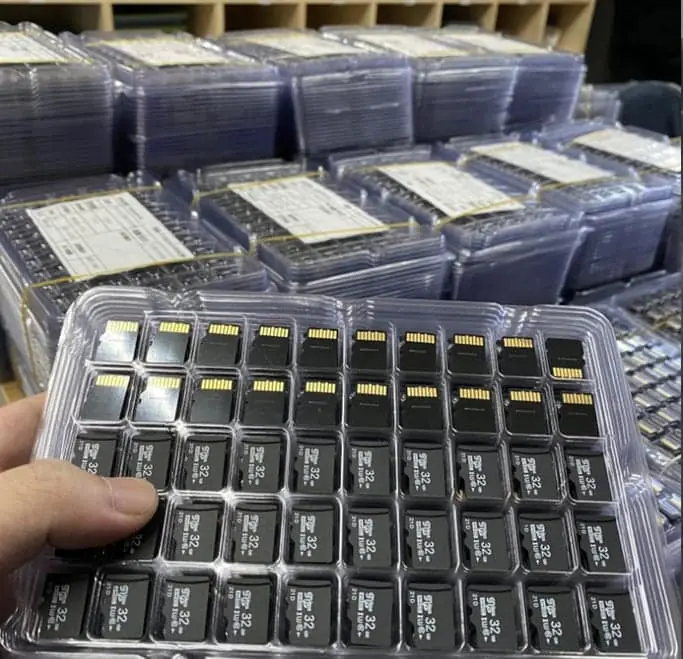
At a glance
- Body styleCard
- MaterialNAND flash in a microSD laminate
- Dimensions15 × 11 × 1 mm
- Weight0.4 g (bare card)
- InterfacemicroSD (TF), UHS-I bus
- Capacities2GB / 4GB / 8GB / 16GB / 32GB / 64GB / 128GB / 256GB / 512GB
- ReferenceTF-C10
What this body is
The card in a dashcam or a CCTV recorder is written to until it fills, then overwritten from the start — thousands of times, in a hot car. That duty cycle, not peak speed, is what the specification should describe.
| Property | Value |
|---|---|
| Format | microSD / TF, 15 × 11 × 1 mm |
| Speed grade | C10 or U3 |
| Capacity range | 2GB – 512GB |
| Sequential read | Up to 25 MB/s on C10; U3 quoted per project |
| Sequential write | ~10 MB/s on C10; U3 quoted per project |
| Bus interface | UHS-I |
| File system | FAT32 up to 32GB; exFAT above 32GB |
| Write-protect switch | None — microSD has no physical lock |
| Operating temperature | Consumer grade; no industrial temperature rating claimed |
| Printing | Card face, to your artwork, or blank |
| Default packing | Bare card |
| Minimum order | 50 pieces per design |
What you can specify on this body
Capacity
2GB · 4GB · 8GB · 16GB · 32GB · 64GB · 128GB · 256GB · 512GB
Interface
microSD (TF), UHS-I bus
Colour
Unprinted · Printed to your artwork
Branding
Card-face printing to your artwork · Blank card supplied unprinted
Packing: Bare card by default. Trays and printed packs are quoted separately, and a printed pack carries its own minimum.
Tooling: The card outline is fixed by the microSD standard — there is no tooling to change it. Card-face artwork is printed, not moulded.
Typical production time once the sample is approved: 1–3 days on stock capacities; printed runs add the print and approval step..
When this one is the right choice
Dashcams and CCTV recorders
Devices that write continuously and overwrite oldest footage first. The relevant number is sustained write and how the recorder handles a full card, not the peak read figure on the pack.
Card-reading speakers and early-learning machines
Small capacities are still the right answer here — 2GB to 16GB covers most of these products, and buying 64GB wastes money on storage the device cannot address.
Buyers printing their own brand on the card
Card-face artwork is printed to order, so a card can carry a brand or a capacity band that belongs to one buyer rather than to a retail line.
When it is not
- Sustained 4K recording where the device manual names V30 or above — that grade is quoted per project, not from this page’s band.
- Applications needing a claimed industrial temperature range or power-loss protection. We do not claim either on this card.
- Buyers who need retail blister packaging as part of the unit price — the card ships bare unless a pack is specified and quoted.
What to confirm before the order is placed
- Check the recorder’s stated bitrate and loop period first. A 4-channel 1080p recorder fills a 64GB card far faster than a single-channel one, and the capacity that “works” depends on how many days of footage you need before overwrite.
- Confirm the device’s maximum supported capacity. Older recorders cap at 32GB and will not mount a 64GB card however it is formatted.
- Send artwork as the printable area, not the whole card. Card-face print has a margin that includes the contacts and the write area.
- Decide whether the card is printed before you approve the sample — printing changes the approval step, not the card.
This body in photographs
Where this body ends up
- Dashcams Continuous overwrite in a hot cabin
- CCTV and surveillance Multi-channel loop recording
- Education and training devices Small-capacity read-mostly use
Quote this body
Send the capacity, the quantity band and the artwork. We reply to business enquiries within 1 business day. Minimum order is 50 pieces per design.
Or email cathy@go-wintel.com — answered by Cathy, sales engineer.
Frequently asked questions
Is a “monitoring” card different hardware from a normal microSD card?
Not in outline or interface — it is the same 15 × 11 × 1 mm card. The difference is in what it is specified and screened for: sustained write and repeated overwrite, rather than peak read speed. Treat “monitoring” as a duty-cycle requirement you write into the order, not a separate product category with its own standard.
Which capacity should a dashcam order use?
Work backwards from the loop period you need. Take the recorder’s total bitrate for all channels, multiply by the hours of footage you want retained, and leave headroom. Most single-channel 1080p installations land between 32GB and 128GB; adding channels or resolution moves that up quickly.
Can the card be printed with our logo?
Yes, on the card face to your artwork. Send the file as the printable area rather than the full card outline, because the margin around the contacts and write area is not printable. Printing is a separate approval step and adds to the lead time.
Do you supply the card with retail packaging?
The default is a bare card. Trays are available for line feeding, and printed retail packs can be quoted — but a printed pack has its own minimum per design that is separate from the card minimum.
What is the minimum order?
50 pieces per design. If the order splits across capacities, each capacity is its own run, so it is worth consolidating to one or two capacities before asking for the price.