
How flash memory pricing actually works
There is no single price per gigabyte for flash memory, and any quote expressed that way is hiding something. Eight variables set your price: capacity, silicon grade and source, die package format, controller solution, interface version, housing material, branding method, and volume against schedule. Two orders for the same capacity can differ substantially in cost because one uses original-grade silicon with a matched controller and the other does not. This page sets out what drives the number, what is included in our quotations, and the one thing most suppliers in this category will not publish: a price range. Custom USB flash drives run US$2 to US$6 per unit at 500 pieces and above; the sections below explain what moves you inside that range. Cards and modules are quoted per project, because silicon grade moves those prices more than quantity does. WINTEL supplies this from its own plant in Shenzhen, China.
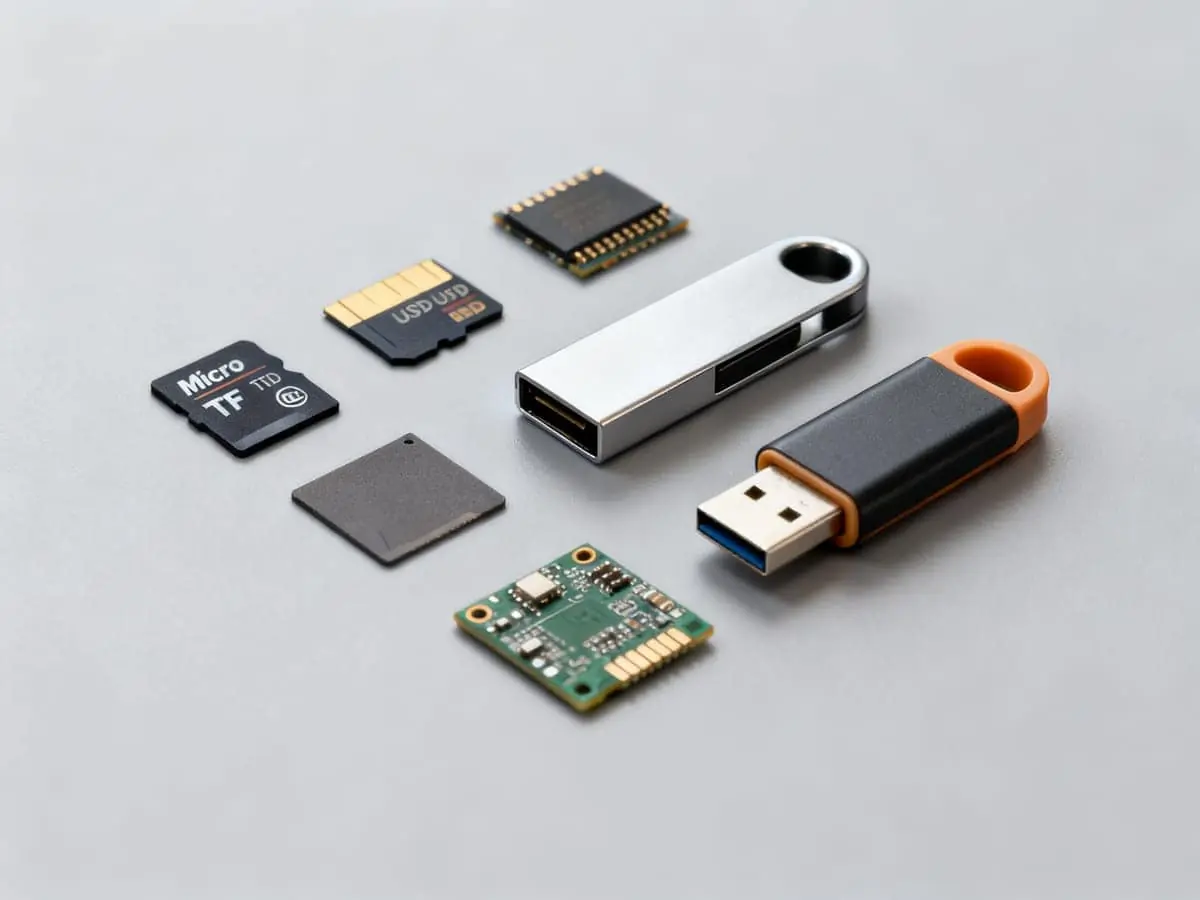
Flash memory pricing is the cost of a defined bill of materials — a NAND grade, a die package, a controller, a housing and a schedule — rather than a rate per gigabyte. WINTEL quotes against a specification from 128MB to 256GB, because the same nominal capacity can be built from parts that differ several times over in cost.
Published price range: US$2–6 per custom USB flash drive
Most suppliers in this category will not put a number on a page, and the reason is usually that the number would embarrass them at one end or the other. We publish one because a buyer pricing a programme needs a working figure before they can even decide whether to run the enquiry.
| What you are buying | Quantity | Published unit price |
|---|---|---|
| Custom USB flash drive, printed logo, standard body | 500 – 10,000 pcs | US$2.00 – 6.00 |
| Custom USB flash drive, new moulded body | from 500 pcs | US$2.00 – 6.00, plus a one-off tooling charge |
| TF / microSD cards | from 50 pcs | Quoted per project — not published as a range |
| UDP flash modules | from 50 pcs | Quoted per project — not published as a range |
Cards and modules are left off the range deliberately: their price is dominated by silicon grade, and a published range would either be too wide to be useful or would quietly describe a lower grade than we would quote. If you need a working figure for a card programme, send the capacity and the grade and we will give you one.
Where you land inside the US$2–6 range
- Capacity. 4GB to 8GB sits at the bottom of the range. 32GB and above climbs toward the top, and 64GB–128GB usually passes it unless the quantity is large.
- Body material. ABS printed all over is the cheapest route. Metal — aluminium or zinc alloy — sits in the middle. A moulded soft-PVC shape is the top of the range before tooling is counted.
- Print method. One-colour silk screen at the bottom; full-colour print or laser engraving higher. Photographic artwork costs more than a logo because it needs more plates or a different process.
- Packaging. Bulk poly bag is the baseline. A printed gift box can add more than the difference between two body materials, which is why we quote it as a separate line.
- Quantity. 500 pieces is the smallest quantity at which the range applies. Below that the setup does not amortise and the unit price leaves the range — we will tell you when it does rather than pretend otherwise.
This is a published range, not a quotation. A firm price needs the capacity, the body, the print file, the packaging and the quantity. What the range is for is telling you whether your budget is in the right order of magnitude before either side spends a week on documents.
What determines your quote
Capacity
Higher capacities consume more die per unit, so price does not scale linearly with size. In a tight market the larger capacities tighten first.
Silicon grade and source
Original-grade silicon from a named source costs more than lower-grade material of unclear provenance. We quote A+ grade and name the sources.
Die package format
TSOP, BGA, LGA, COB and eMMC carry different costs. The right format depends on capacity, cost target and mechanical constraints.
Controller solution
Alcor, ITE, Xinbang and Micov in QFN, 24-pin, 48-pin or COB packages differ in cost, and the right choice depends on your host.
Interface version
USB 3.0 costs more than USB 2.0. Specify the interface your application actually needs rather than defaulting to the higher one.
Housing and body material
Metal, PVC and wood bodies differ in cost, and a bespoke mould adds tooling. Tell us the body for an accurate figure.
Branding method
Silk-screen printing, full-colour printing and laser engraving are priced differently, and the achievable method depends on the body material.
Volume and schedule
Unit price falls with volume. Delivery date affects cost too — a compressed schedule may require a different sourcing route.
How quoting works
- You send the requirement Product type, capacity, interface, quantity, branding, housing, target date and target market.
- We confirm the specification Including the silicon source and controller solution, in writing, before pricing it.
- We quote against that specification With the full cost of product, branding and packaging stated, plus the schedule and the quotation validity period.
- You approve a sample Before bulk production begins, particularly for bespoke moulds and colour-critical branding.
Terms stated on the quotation
Commercial terms are not hidden behind "contact us for details". They are written into every quotation, and these are the lines that carry them:
- Payment terms 30% deposit, 70% balance before shipment (T/T)
- Incoterms FOB Shenzhen
- Shipping origin Shenzhen, Guangdong, China
- Quotation validity 30 days
Terms are confirmed per order against your specification — they are not a generic rate card.
What is included
- The product at the agreed specification
- Branding at the agreed method
- Packaging as specified in the quotation
- Capacity and read/write verification before packing
- The schedule, stated in the quotation
- The quotation validity period, stated in the quotation
What we do not do
- Costs that would be added after you accept — there are none. If something is not in the quotation, we will flag it before you order rather than after.
- Guarantees we cannot document — for example an endurance figure or an industrial temperature rating for a part that does not carry one.
- Generic MOQ or lead time figures that pretend to apply to every order. Both are confirmed against your specification.
One exception: clearance stock
Everything above is about quoting a specification. There is one case where a lower price is published in advance rather than quoted: overstock lots already in our warehouse — production overruns, cancelled orders and the tail of completed runs.
Those units are cheaper because the tooling, sample round and production slot behind them have already been paid for, not because the flash is a lower grade. The trade-off is that quantity is fixed, the body and surface cannot be changed, and the lot does not restock. If your need is repeatable, it belongs in a quotation against your specification, not in a clearance lot.
Who this page is for
It is written for buyers who are comparing quotes and want to know what to compare. If you are buying a single drive for personal use, we are not the right supplier — we work on project volumes and confirm terms per order.
If you are sourcing flash as a component or a branded product and need to know what you are paying for, send us the specification and we will quote it line by line.
Pricing questions
Can you give me a price per GB?
No, and be cautious of anyone who does. Price per GB varies with silicon grade, package format, controller, interface, housing, branding, volume and schedule. A single rate would be accurate for none of those combinations.
Why is the price higher than a quote I received elsewhere?
Ask what grade of silicon the other quote specifies, and whether it names the source. A lower price can mean lower-grade material rather than a better deal. Both may be legitimate for different applications — the point is to compare like with like.
How long is a quotation valid?
Ask for the validity period explicitly on every quote, from us and from anyone else. Given the pricing movement across memory in 2026, an open-ended quotation is not a meaningful commitment.
Do you charge for samples?
Sample terms depend on the configuration and the volume you are considering. Ask when you enquire and we will state the terms on the quotation rather than leaving it to be discovered later.
What is the minimum order quantity?
MOQ depends on product type, capacity, controller solution and whether tooling is required. Send your specification and we will confirm the MOQ alongside the price.
Are there tooling or artwork charges?
A bespoke mould means tooling, and it will be stated in the quotation if it applies. Branding is quoted as part of the total cost of the product, not added afterwards.
What payment terms do you offer?
Payment terms are stated on the quotation for your specific order rather than advertised as a one-size rate. The lines above show where they appear. Ask us directly and we will put them in writing before you commit.
Send your specification and we will reply within 1 business day.
Or email cathy@go-wintel.com — answered by Cathy, sales engineer.