
UDP Module Manufacturer — Embedded Flash for OEM & ODM
UDP stands for USB Disk in Package: a complete USB flash device built on a single small board that you solder directly onto your own PCB instead of plugging in a removable drive. WINTEL UDP modules measure 11.3 × 24.8 × 1.45 mm and weigh 0.819 g, with USB 2.0 or USB 3.0 interface and capacities from 128MB to 128GB. Read and write speed is specified per project, and the controller solution is selected to match your host. This is the part you choose when your product needs internal storage that is fixed, compact and tamper-resistant — industrial controllers, embedded devices, POS and medical terminals.
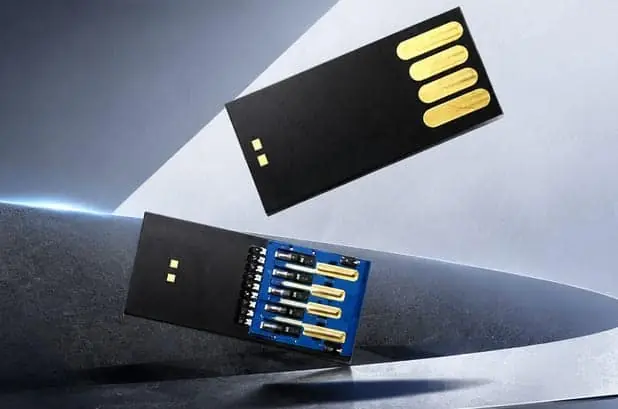
Specifications
- Dimensions11.3mm × 24.8mm × 1.45mm
- Weight0.819g
- InterfaceUSB2.0 / USB3.0
- Flash gradeA+ Grade
- Capacities128MB / 256MB / 512MB / 1GB / 2GB / 4GB / 8GB / 16GB / 32GB / 64GB / 128GB
What you can specify
- Capacity selection (128MB–128GB)
- USB2.0 or USB3.0
- Read / write speed (specified per project)
- Controller solution matched to your host
Where it is used
- IoT & embedded devices Soldered-on internal storage
- Security & IP cameras Fixed internal recording media
Supply notes
- Die formats available: TSOP, BGA, LGA, COB, eMMC
- Controller packages: QFN, 24-pin, 48-pin, COB
- Controller solutions: Alcor, ITE, Xinbang, Micov
Which flash format fits your design
Four formats leave this factory, and the difference between them is mostly mechanical: whether the storage is removable, whether it is sealed inside the product, and who owns the housing. Compare them before you compare prices, because they are not interchangeable.
| Format | What it physically is | Choose it when | The trade you are making |
|---|---|---|---|
| TF card (microSD) | 15 × 11 × 1 mm removable card, 0.25 g | Devices that already have a card slot; storage the end user or field engineer can swap | The socket is the mechanical weak point, and the card is only as good as its grade |
| UDP module — this page | Encapsulated die + controller, no housing, no connector | Sealed, soldered-down storage for small devices — no socket, no shell, no user access | Needs a PCB footprint and reflow assembly; cannot be replaced in the field |
| USB flash drive | Finished drive: connector, controller and housing | Branding, gifting, software and media delivery, retail-ready presentation | Housing, print and packaging — not the silicon — drive the cost and the MOQ |
| Semi-finished PCBA | Assembled flash board, no housing, no branding | Buyers who already own the shell, the print process or the final assembly line | You carry the tooling and the branding yield, and the warranty boundary sits with you |
If the design is already committed to a soldered part, the UDP module manufacturer page carries the integration detail — die formats, controller packages, and what to put in the specification before you ask for a drawing.
Applications
Customization
- Capacity selection (128MB–128GB)
- USB2.0 or USB3.0
- Read / write speed (specified per project)
- Controller solution matched to your host
What to put in the UDP Module specification
A UDP module is bought as a component, so the specification is the whole contract. There is no retail box and no visible branding to argue about — only silicon, package, firmware and test coverage.
- Package format TSOP, BGA, LGA, COB and eMMC differ in footprint, assembly method and how much of the die is protected. Choose the package your board was laid out for. Read more →
- Capacity and die configuration One die or several stacked. It changes the footprint, the yield and how the controller maps bad blocks.
- NAND grade and die source Original, white or black die is a price decision with an endurance and consistency consequence. If the grade is not written down, you are not buying a grade. Read more →
- Controller solution The controller decides power-loss behaviour, wear levelling, host compatibility and whether a second source exists later. Name it, and ask about alternates. Read more →
- Endurance class SLC, MLC and TLC trade cost against rewrite cycles. A data logger and a firmware store do not need the same cell type. Read more →
- Interface and host The host side of the interface and the protocol it expects. Send the host details — it is the fastest way to rule out a compatibility problem before tooling.
- Test coverage Say which tests you require at module level: capacity verification, read/write, bad-block count, retention. Test coverage is a line item, not an assumption. Read more →
- Reflow profile source The reflow curve comes from the device datasheet for the package you choose, then must be validated on your own line and board thickness. We supply the datasheet for the package used on your modules; we do not invent a curve that ignores your assembly conditions. Confirm moisture sensitivity and peak temperature before the first run. Read more →
- Traceability Lot code and die marking let you trace a failure back to a batch. Ask for the marking convention in writing before the first shipment. Read more →
Manufacturing process
Each unit is built from sourced NAND and a controller solution selected to your host and workload, placed and soldered on our own SMT line, programmed, then capacity-verified with a full write-and-read-back and read/write tested before packing. The same configuration is held across repeat batches.
Test conditions, BOM and what we declare
A capacity or speed figure without the conditions behind it is not checkable. These are the conditions we test under, and the claims we will put in writing on the quotation.
| Check | Method and condition | What it establishes |
|---|---|---|
| Capacity | Full write-and-read-back with H2testw or F3, on a known-good reader over the interface quoted | The unit stores the capacity it claims, end to end |
| Read / write | Sequential transfer of a single file larger than the cache, repeated, on the quoted interface | The sustained figure for that configuration, not a peak burst |
| Reader recognition | Enumeration on Windows, macOS and Linux hosts | The unit mounts and reports its capacity across systems |
| Appearance and print | Visual check against the approved sample under neutral light | Branding and body match what was approved |
Bill of materials
NAND source, grade, controller solution and package format are stated on the quotation before the order is placed. A substitution is raised with you before it is made — it is not something you discover on arrival.
Batch consistency
The approved configuration is held across repeat batches: same silicon grade, same controller, same test method. Sample size and acceptance criteria are agreed per batch and written into the order rather than assumed.
Compliance documents
RoHS documentation and SGS test reports are available on request. CE and FCC are market requirements we build against; we do not claim to hold certificates we have not been issued.
What we do not publish
A machine-readable datasheet per model is not available yet. Dimensions and weights are measured; tolerances and test logs are quoted per order rather than published as a generic figure.
This is for you if
- Product designers integrating fixed internal storage
- Industrial, POS and medical device builders
- Buyers who need a datasheet-level part rather than a consumer drive
This is not for you if
- Buyers looking for a removable USB stick
- Anyone searching for a network protocol module — "UDP" here means USB Disk in Package, not User Datagram Protocol
- Designs needing an officially rated industrial-temperature or automotive-qualified part
What fails in the field, and what prevents it
Because a UDP module disappears inside the product, its failures are expensive to diagnose and impossible to service in the field. The prevention is all in the specification and the incoming test.
The die grade is not what the price implied
Graded die is sold by grade, and the difference shows up as endurance and consistency rather than as an immediate failure. Verify the marking and the lot, not just the capacity.
Original, white or black die →Bad blocks appear after assembly
Every NAND device ships with some bad blocks; the question is whether the controller maps them properly and whether your host tolerates the mapping. This is a firmware and test question, not a silicon question.
What the controller does with bad blocks →The package does not survive the reflow profile
A package chosen for footprint reasons may not match your assembly temperatures or moisture sensitivity. Confirm the package against your line, not only against your layout.
TSOP vs BGA vs LGA vs COB vs eMMC →A single-sourced controller leaves you stuck
Once the firmware is tied to one controller, an allocation problem at that supplier becomes your production stop. Ask what the alternate is before you commit to volume.
The trade in single-sourcing a controller →Ordering UDP Module: MOQ, samples, lead time and testing
| Question | Answer |
|---|---|
| Minimum order quantity | Set by capacity, controller solution and how much customisation is involved — confirmed with your quotation. See how MOQ is set. |
| Samples | Available, and recommended before volume — particularly for printed artwork or a bespoke mould. See how samples work. |
| Lead time | Depends on configuration, branding and whether tooling is needed. Confirmed in the quotation against your target date. See what drives lead time. |
| Testing | Capacity and read/write verification before packing. You can verify independently with a full write-and-read-back — the method is published here. |
| How to request a quote | Product type, capacity, quantity, application and target date is enough to start. Open the quote form, or see what to include. |
Specify your udp module
Tell us the capacity, quantity, application and target date. We confirm MOQ and lead time against your specification rather than quoting a generic figure — and we reply to business enquiries within 1 business day.
Or email cathy@go-wintel.com — answered by Cathy, sales engineer.
From the factory floor
Photographs taken at our own facility in Shenzhen. Nothing on this page is a stock image or a rendering of a product we do not make.
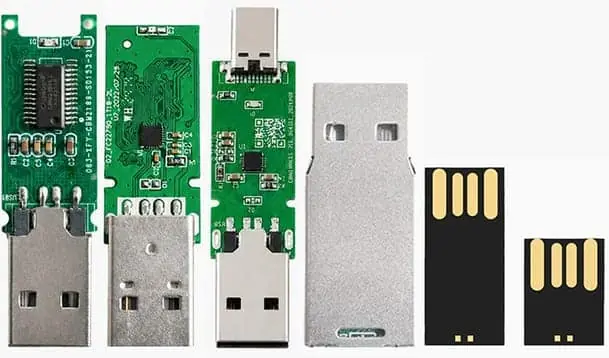
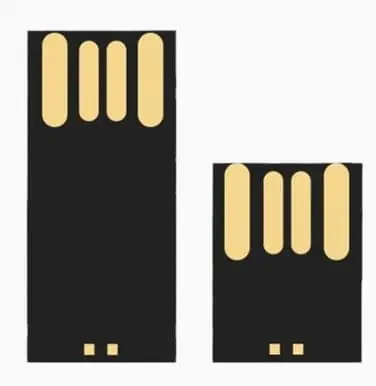
UDP Module — the bodies we run
Each body below is a distinct shell, not a colour option on the same tooling. The flash inside is the same; what changes is the case — dimensions, weight, print area and how the drive is carried.
| Body | Style | Dimensions | Weight | Capacity |
|---|---|---|---|---|
| Black epoxy UDP 25 × 11 | Bare module | 25 × 11.3 × 1.4 mm | 0.819 g | 4GB–32GB |
UDP Module — frequently asked questions
What does UDP mean here?
UDP = USB Disk in Package. It is a physical format, not a network protocol. A UDP is a complete USB flash device on a small board that is soldered onto your PCB. If you were looking for User Datagram Protocol, that is a different subject entirely.
How is a UDP different from a PCB flash drive?
A PCB drive is a finished, removable USB stick built on a circuit board and fitted into a housing. A UDP goes further — the die is bonded directly with no removable housing, making it thinner and fixing it permanently into your product. See our comparison of UDP, PCB and COB formats.
Which controller will you use?
We select from Alcor, ITE, Xinbang and Micov, in QFN, 24-pin, 48-pin or COB packages. The choice depends on your host system, capacity and required speed. Tell us your host and we will propose the matched solution.
Can you supply a datasheet?
Yes. Send us your integration requirements — host interface, capacity, speed and mechanical clearance — and we will provide the matching specification and drawing for your design review.
Is there a minimum order quantity?
MOQ depends on capacity, controller solution and customisation. Share your specification and we will confirm MOQ with the quotation.