
Standard black epoxy UDP flash module sizes — long version, short version, how thick it is, and how it compares to a microSD card and a semi-finished board.
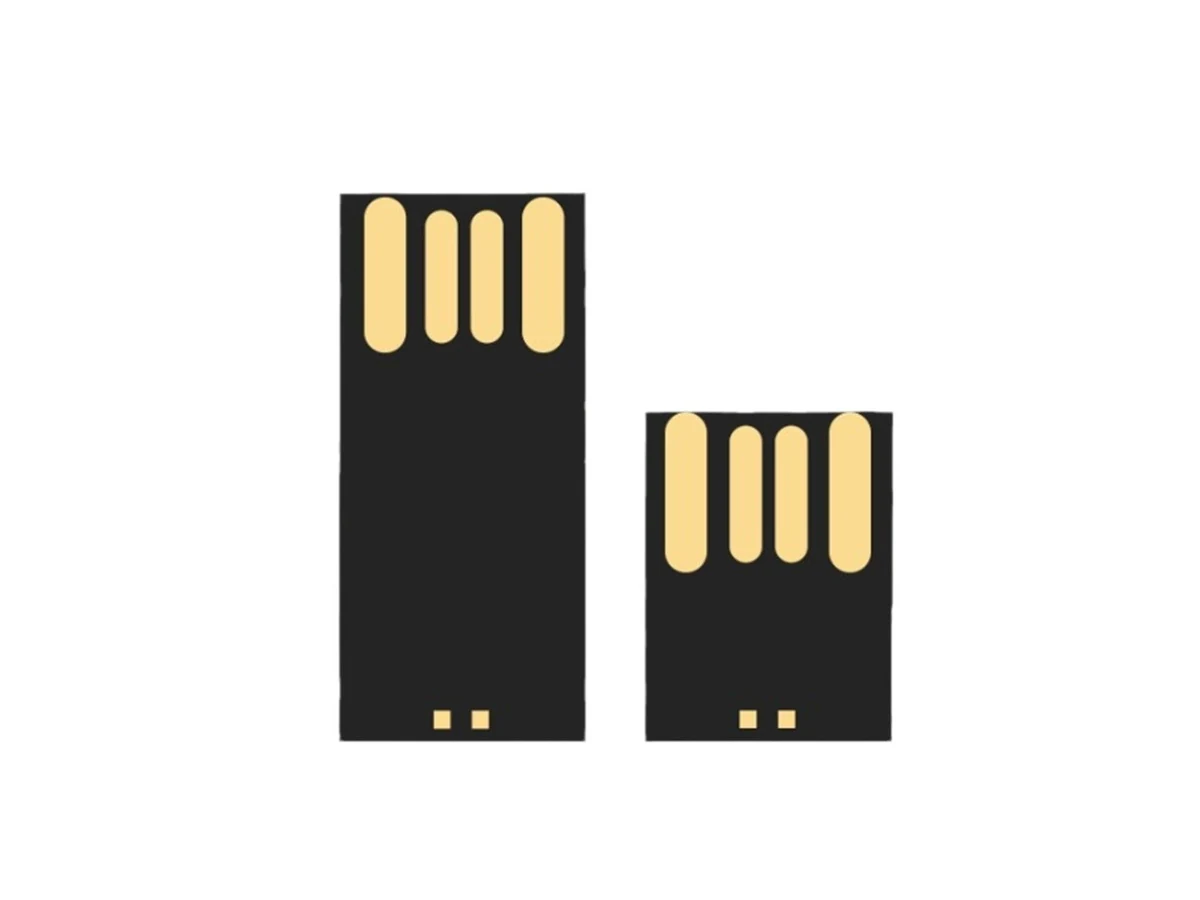
The standard black epoxy UDP (USB Disk in Package) flash module is 11.3 mm wide, 1.4 mm thick, and comes in two lengths: 24.8–25 mm (long version) and 16.8–17 mm (short version). The long version is the most common and the cheapest; the short version is used where space on the PCB is tight. A UDP module is smaller than a microSD card (11 × 15 × 1 mm) and much smaller than a semi-finished USB board (12 × 48 × 4.5 mm). Weight is about 0.8 g per module. WINTEL supplies this from its own plant in Shenzhen, China.
The short answer: the standard black epoxy UDP module is 25 × 11.3 × 1.4 mm (long version) or 17 × 11.3 × 1.4 mm (short version).
On an SMT line the millimetres decide your feeder cost. A customer spec’d a module 0.3 mm thicker than our standard and suddenly needed a custom pocket in every feeder — hundreds of dollars and a week of lead time for a size nobody asked for. Tell me your pick-and-place model and I will pick the envelope that drops into a standard feeder rather than a custom one.
UDP sizes look identical in a datasheet and feel completely different on an SMT line. The millimetres decide whether your pick-and-place can place it without a custom feeder.
If you are designing a PCB and wondering whether a UDP chip will fit, the exact numbers matter — because 0.5 mm of clearance can be the difference between it fitting and not.
This page covers the standard sizes, how they compare to other formats, and what to check before you finalise a board design.
Standard sizes, by format
| Format | Length | Width | Thickness | Typical capacities |
|---|---|---|---|---|
| UDP long (standard) | 24.8–25.0 mm | 11.3 mm | 1.4 mm | 4GB – 32GB |
| UDP short | 16.8–17.0 mm | 11.3 mm | 1.4 mm | 4GB – 16GB |
| microSD card | 15.0 mm | 11.0 mm | 1.0 mm | 4GB – 256GB |
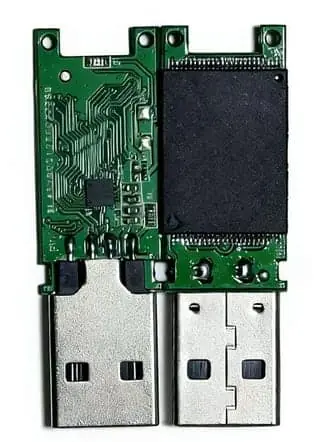
| Semi-finished USB board | 48.0 mm | 12.0 mm | 4.5 mm | 128MB – 128GB |
UDP long is the default. It is the cheapest, the most widely available, and what you get unless you specify otherwise.
UDP short is used where board space is tight — inside small gadgets, compact IoT devices, and anywhere the extra 8 mm of length would not fit. It is slightly more expensive because the package is less common.
Why the numbers are ranges, not exact
If you look at five different suppliers’ datasheets, you will see five slightly different numbers. Some say 24.8 mm, some say 25.0 mm, some say 25.2 mm.
This is normal and it is not an error. The epoxy moulding process has a tolerance of about ±0.2 mm. Every batch is slightly different.
Design rule: always add 0.3 mm clearance on every side. If your board has a 25.5 mm space, a 25.0 mm module should fit — but the closer you cut it, the higher the chance that one batch is slightly oversized and does not go in.
For high-volume designs, we always recommend getting samples and measuring them yourself before you finalise the PCB.
The contact pads
The USB contact pads are on the bottom of the module. Their position is standardised enough that most modules are drop-in compatible, but there are small differences between manufacturers.
| Feature | Typical dimension |
|---|---|
| Pad length | ~12 mm |
| Pad pitch | ~2.5 mm between contact centres |
| Number of pads | 4 (USB 2.0 standard) |
| Pad width | ~1.5 mm |
| Distance from front edge | ~2 mm |
If you are designing a socket or a board footprint, always check the datasheet for the specific module you are using. Do not assume all UDP modules are pin-identical — most are, but “most” is not “all.”
Weight
A standard long UDP module weighs about 0.8 grams. The short version is slightly lighter, around 0.6 grams.
This matters when:
- You are designing a very lightweight device
- You are calculating shipping costs for large quantities
- The device has weight restrictions (drones, wearable tech, etc.)
For reference, a semi-finished USB board weighs about 3.2 g — roughly four times as much.
How to choose between long and short
Choose long UDP if:
- Board space is not tight
- You want the cheapest option
- You need 32GB capacity (short UDP usually stops at 16GB)
- You want the most widely available format
Choose short UDP if:
- The PCB is under 20 mm long
- The device has a tight enclosure
- Capacity under 16GB is acceptable
- The extra cost per unit is not a problem
If you are not sure which one fits your design, request datasheets for both versions and I will send you the exact dimensions, pad layout, and recommended footprint. No obligation — just the data you need to design the board right.
One important note about custom sizes
We are sometimes asked: “can you make a UDP module that is exactly X by Y millimetres?”
The answer is: theoretically yes, practically no — not at low volumes. Custom epoxy packaging requires a custom mould, custom tooling, and a minimum order of tens of thousands of pieces. The tooling cost alone is in the thousands of dollars.
For anything under 10,000 pieces, your best bet is to design the board around one of the two standard sizes. Long and short are the only two that are stocked and immediately available.
Need exact dimensions for your PCB design? Send us the model you are considering and I will send you the full datasheet with pad layout, recommended footprint, and tolerance ranges.
I will give you the real envelope drawing, not the marketing one. A 0.2 mm difference is the difference between a standard feeder and a custom one you pay for.
Tell me your pick-and-place model and target enclosure depth, and I will send the exact envelope drawing before you design the housing around it — that one email prevents the most expensive mistake in this whole category.
What to send us for an accurate size quote
To quote the right UDP or board without a guess, send three numbers and one drawing: the maximum length, width and height your enclosure allows, and a sketch of where the flash sits relative to the connector. With those I can tell you whether a standard module fits or we need a custom substrate — and whether your SMT line needs a standard or custom feeder.
Frequently asked questions
Are UDP modules all the same size?
No. The most common size is 25 × 11.3 × 1.4 mm (long version), but there is also a short version around 17 × 11.3 × 1.4 mm, and some special sizes for specific applications. Always confirm before you design the PCB.
How thick is a UDP module including the solder pads?
The epoxy body itself is 1.4 mm thick. The contacts on the bottom add about 0.1–0.2 mm, so total height after soldering is about 1.5–1.6 mm above the board.
Can I replace one brand of UDP with another?
Not always. While the pinout is often standard, dimensions can vary by 0.2–0.5 mm between manufacturers. If board space is tight, get the exact datasheet for the specific module you are buying.
What capacities do UDP modules come in?
Standard UDP modules range from 4GB to 32GB. Above 32GB the die package gets too large for the epoxy body, so you need a semi-finished board format instead.
Can you supply UDP modules with specific length requirements?
Standard lengths are long (~25 mm) and short (~17 mm). Custom lengths are possible at high volumes but require a custom package, which adds cost and lead time.