Wooden USB Flash Drives
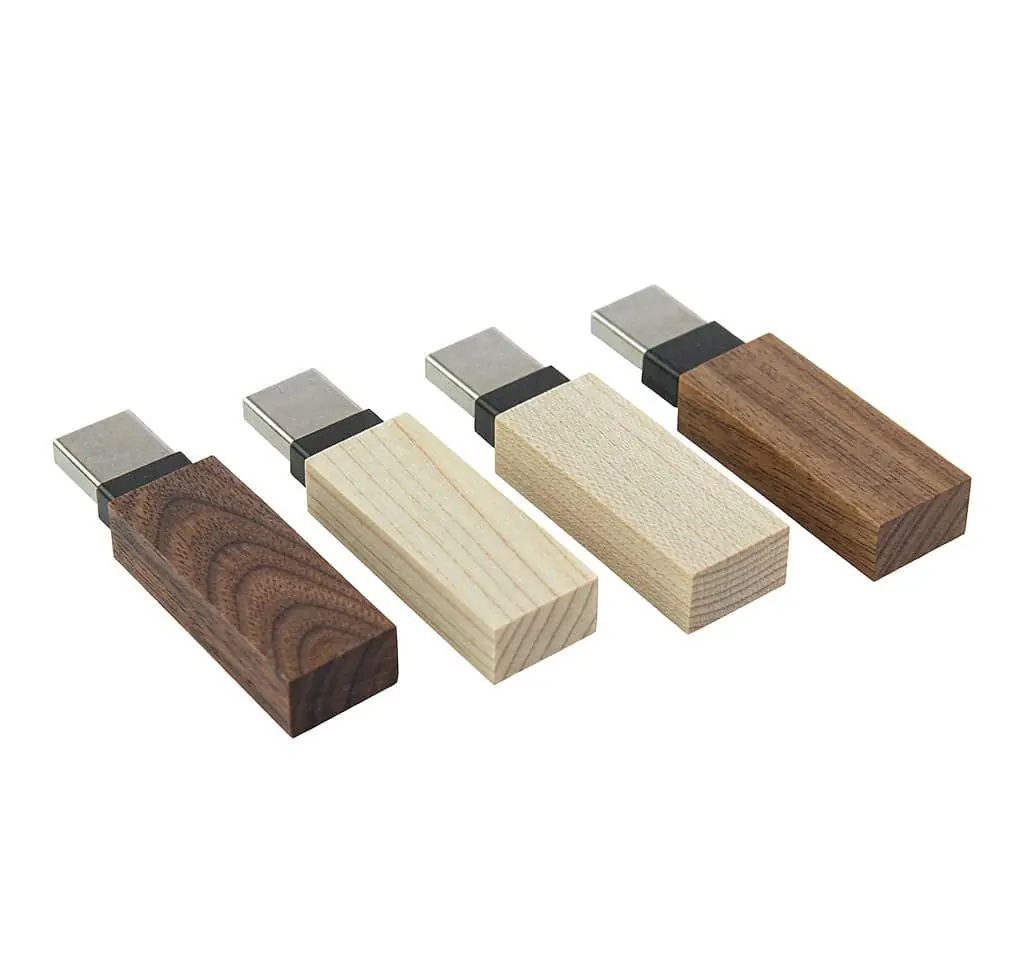
Wooden USB flash drives carry a natural, considered look that print-on-plastic cannot imitate — which is why they are the standard body for eco-positioned brands, wedding studios and premium packaging sets. WINTEL produces wooden bodies in walnut, bamboo and maple tones with laser engraving as the natural branding method, 128MB to 128GB inside, and USB 2.0 or 3.0. One thing we say plainly: wood grain varies between units. Engraving sits on a living surface, and no two drives are identical — most buyers see that as the point, but it should be a decision, not a surprise. Physical samples are approved before bulk production.
Key facts
- BodyWood — walnut / bamboo / maple tones
- BrandingLaser engraving (natural choice); print available
- Capacity128MB – 128GB
- InterfaceUSB 2.0 / USB 3.0
- Honest noteGrain varies unit to unit — inherent to the material
- PositioningEco brands, wedding & photography studios, premium packaging
- SampleApproved before bulk production
- MOQ / lead timeConfirmed with the quotation
Is wood the right body?
Suits
Eco-positioned brands, wedding photographers and studios, presentation-box sets, campaigns where a natural look is part of the message.
Consider other bodies if
Every unit must look absolutely identical (metal or PVC), the design needs sculpted detail (PVC), or the brand mark is photographic rather than line-art.
Which wood should the order use?
Three timbers cover almost every wooden order, and they are not interchangeable once artwork is involved: the same logo does not read the same way on all three.
| Wood | Colour and grain | Engraving contrast | Where it suits | What to watch |
|---|---|---|---|---|
| Walnut | Dark brown, straight to mildly figured grain | High — the burn reads clearly against dark timber | Corporate gifts, premium presentation sets | Dark timber swallows fine text below about 1 mm cap height |
| Bamboo | Pale straw, dense linear fibre with visible nodes | Low to medium — a light mark on a light surface | Eco campaigns, sustainability reporting | A node line can cross a logo; placement has to be agreed on the sample |
| Maple | Pale cream, fine and even texture | Medium — clean edges, moderate contrast | Weddings, photography studios, retail sets | Shows handling marks and finger oils sooner than walnut |
Other species are quoted per project rather than held as stock. If the timber has to match an existing packaging set, send the reference before the artwork is finalised — the engraving result depends on it.
How does engraving behave on wood?
Line-art and text engrave cleanly on all three timbers. What changes is contrast, not legibility: the same logo reads as a dark mark on maple and a mid-tone mark on walnut.
Fine detail has a floor. Below roughly 1 mm cap height the burn line starts closing up in open grain, and the mark becomes a smudge at arm’s length. If the artwork cannot be simplified, print on a flat body is the honest alternative.
Depth is set by power, not by artwork. Ask for the depth on the sample and check it on the batch — a deeper burn gives more contrast and more chance of chipping at the edge of the mark.
Engraving cannot reproduce a photograph or a gradient. It is a single-tone burn. Multi-colour on wood means printing on a painted or lacquered face, which is a different product with a different wear behaviour.
What fails first on a wooden drive?
Moisture, not impact, is what kills a wooden drive. Timber dried to the wrong figure keeps moving after assembly: in a heated office it shrinks and the seam opens, in a humid warehouse it swells and the two halves stop sitting flush. The electronics are unaffected — the product simply looks wrong.
Screw threads in timber strip. A body held by self-tapping screws into wood can be opened once or twice before the thread gives up, which matters if the drive is designed to be serviced or reloaded.
Colour is not repeatable across batches the way moulded plastic is. Two runs of walnut from different boards will not match under a colour meter, and a reorder six months later will look like a different product unless the finish and the timber source are pinned on the specification.
Engraving chips at the edge on dense, dry timber. It shows as a pale halo around the mark and is most visible on bamboo, where the fibre runs straight through the letters.
How is a wooden batch inspected?
- Spread the batch and judge grain and colour as a group, not unit by unit — the question is whether the spread is acceptable, not whether one drive is perfect.
- Engrave depth: check that the mark is consistent across units and that no letter has closed up. A loupe on three units tells you more than a photograph of one.
- Fit and seam: press the two halves together and look for a gap that opens under thumb pressure. That is the moisture symptom, and it appears before anything electrical does.
- Moisture: ask for the timber’s moisture content at assembly in writing. If a supplier cannot state it, the batch is a lottery rather than a specification.
What the specification must state
- Wood species and tone, named — "walnut", not "wood".
- Engraving: artwork file, cap height, and the depth agreed on the sample.
- Finish: raw, oiled or lacquered, and whether the engraved area is left bare.
- Capacity band, interface version and speed class, stated separately from the body.
- Acceptable grain and colour variation, in words — this is the clause that prevents a reorder dispute.
- Packaging: poly bag, gift box or retail blister, and whether the box carries its own printing.
Send those six lines with the artwork and you will get a quotation that can be compared with another supplier’s. Send “wooden USB drives with our logo” and you will get a price for a different product from each factory.
Request a wooden USB drive quotation
Wood tone, capacity, engraving artwork and quantity. We reply to business enquiries within 1 business day.
Or email cathy@go-wintel.com — answered by Cathy, sales engineer.
Frequently asked questions
Which woods are available?
Walnut, bamboo and maple tones as standard. The tone affects the engraved contrast — light engraving on walnut reads differently than on maple. We will confirm the result on a sample.
Will every wooden drive look the same?
No — and we say so up front. Grain varies between units because wood is a natural material. If uniformity is essential, metal or PVC is the better body choice, and we will say that too.
Can our logo be engraved on wood?
Yes — laser engraving is the natural method on wood. Line-art logos and text marks engrave cleanly; fine photographic detail reproduces better with print on other materials, and we will advise honestly.
Is bamboo available for eco-positioned campaigns?
Yes, bamboo is one of the standard tones. The eco story of the campaign belongs to your brand positioning — what we can document is the material, the engraving and the specification of the electronics inside.
Can you print in colour on a wooden body?
Only on a painted or lacquered face, which is a different product: the ink sits on a coating rather than in the timber, and it wears at the edges. If full colour is essential, a metal or ABS body carries it better.
Do wooden drives cost more than metal?
They sit in a similar band at the same quantity, and both avoid the mould cost that soft PVC carries. Timber selection and engraving depth move the number more than the material name does — confirm against your artwork, not against a published price.
What moisture content should the timber be?
Ask for the figure at assembly and get it in writing. The number itself matters less than consistency between batches: a body that moves after assembly opens at the seam even though nothing electrical has failed.
How long does a wooden order take?
Body supply, engraving and assembly are separate stages, and engraving is the one that scales with order size. The lead-time guide breaks the stages down; the figure that applies to your order is confirmed on the quotation.