
Four checks you can run from your desk: the Chinese business scope, the registered address, the capacity arithmetic, and one verified certificate number.
The short answer
Four checks separate a factory from a sales office, and all four run from your desk.
- Read the business scope in Chinese. 生产 / 制造 / 加工 means production runs here. 销售 / 批发 / 零售 means goods pass through.
- Put the registered address on a satellite map. An industrial yard has loading bays; a business centre has a car park.
- Do the arithmetic on the monthly figure. Per product line, not one round number covering everything.
- Resolve one certificate number at the issuing body. A scan is not a certificate.
A trading company passes none of the four without help. None of the four needs a plane ticket, and none is conclusive on its own — the last section is about what this routine misses.
Check 1 — The registry line, and the verb in it
Every legally registered company in China sits in one public register: 国家企业信用信息公示系统, at gsxt.gov.cn. Search the Chinese name. The English trading name on the quotation returns nothing, because the register does not hold it.
The record returns the legal name, registration date, registered address, registration authority and business scope. It also carries a Unified Social Credit Code (统一社会信用代码) — 18 characters, five fields, fixed order:
| Positions | Field | What it tells you |
|---|---|---|
| 1 | Registration authority | Which department registered the entity |
| 2 | Entity category | What kind of organisation it is — the useful one |
| 3–8 | Administrative division | Where it was registered, as a six-digit area code |
| 9–17 | Subject identifier | The entity’s own identifier, stable across renames |
| 18 | Check character | Detects a mistyped code |
The second character is worth memorising. Under the market-regulation authority, 91 is an enterprise (企业), 92 is an individual industrial and commercial household (个体工商户), and 93 is a farmers’ professional cooperative.
A 92 is not fraud — plenty of legitimate small workshops hold one — but liability sits with a person rather than a company, there is no shareholders’ register behind it, and the entity can be deregistered in a way a limited company cannot. Before a five-figure deposit, that difference is worth knowing.
Positions 3–8 are the administrative division. A Shenzhen entity carries 440300. If the quotation header says Shenzhen and that field says something else, one of the two is decoration.
Then read the scope line, which is written in a small set of standard phrases:
| If the scope contains | Registered to | English wording you will see |
|---|---|---|
| 生产 / 制造 / 加工 / 组装 | manufacture or process | production, manufacturing, assembly |
| 销售 / 批发 / 零售 | buy and resell | sales, wholesale, retail |
| 贸易 / 进出口 | trade | trading, import/export |
| 技术服务 / 研发 | develop, not produce | technical services, R&D |
“We make USB drives” and “we sell USB drives” are the same sentence in English and different entries in the registry. A scope holding only the commercial terms describes a company that buys and resells — which is legal, common, and often competent, but cannot answer for a production floor.
Two caveats, because this is an indicator rather than a verdict. Manufacturing sometimes sits in a related entity under the same owner, and scopes are written once at registration and rarely updated. Some factories keep narrow scopes for tax reasons. The check is cheap for a real plant to pass and awkward for a sales office to fake.
Check 2 — The address, and the walkthrough behind it
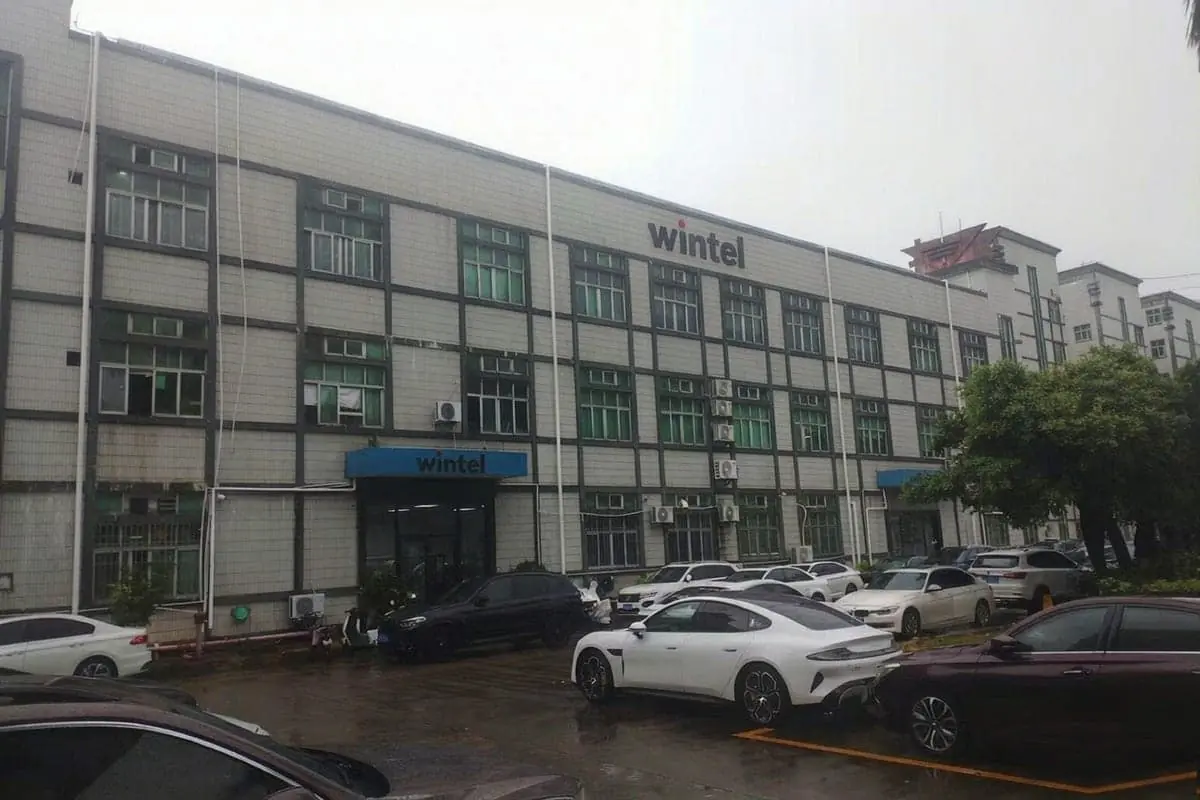
Three addresses have to agree: the registry, the invoice header, the contact page. Then open the registry address in a map with satellite view.
An industrial building has loading bays, a yard, and a roof covered in extractor units. An office tower has a lobby and a car park. Floor 23 of a business centre is not a plant, and if the certificate names a site in another district, ask why before you ask anything else.
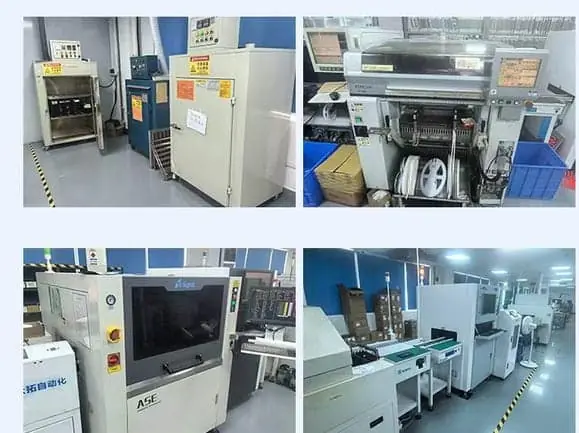
A gallery of tidy photos proves a camera works. What proves a line is a walkthrough you scheduled, at a time you chose, with a request attached: one continuous shot from the die store to the packing bench. Continuous is the part that is hard to stage — and the part where you see whether the die store is locked, whether rework has its own area, and whether the bench that tests is the bench that packs.
Check 3 — The capacity arithmetic
Ask for monthly output per product line. “Five million units a month” means nothing until you know whether it counts UDP modules, TF cards or finished drives in housings — three lines, three rates, three bottlenecks.
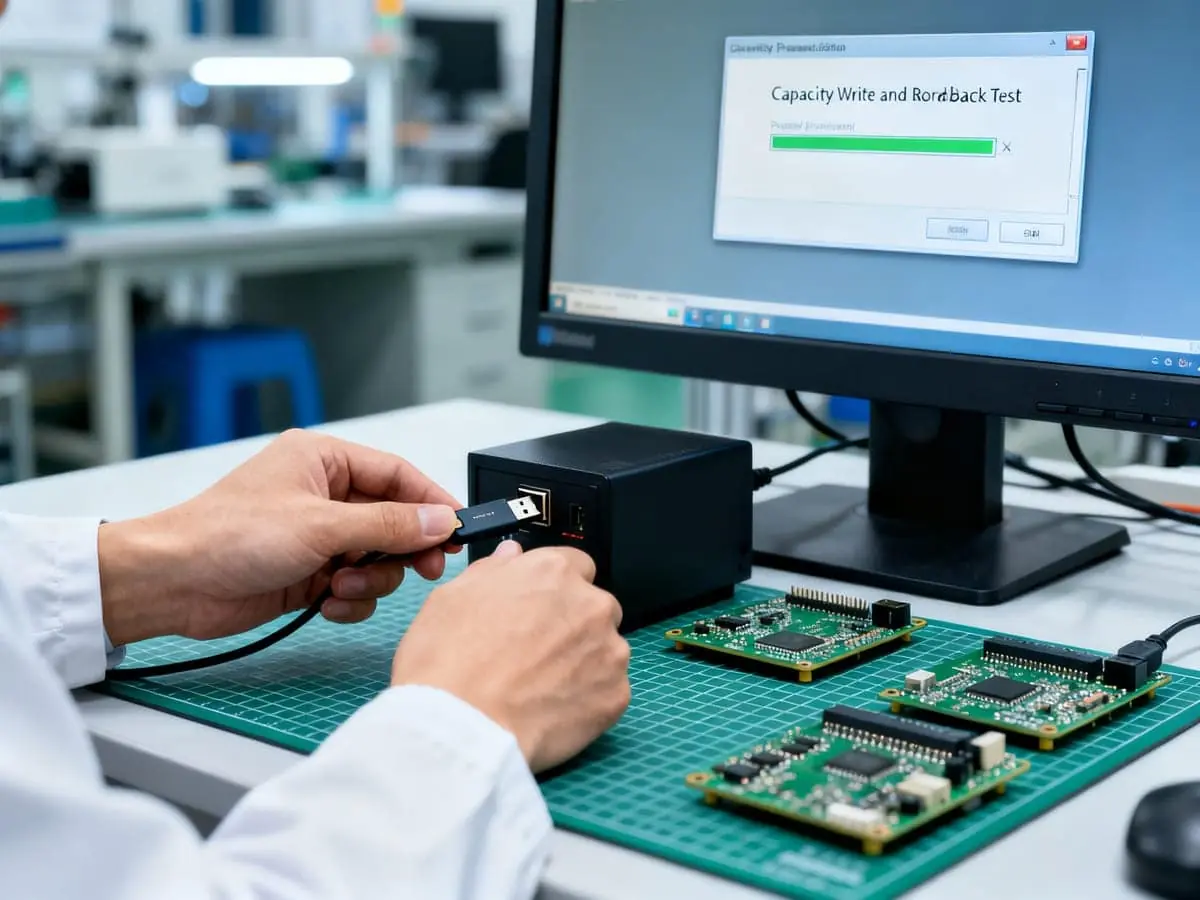
A month is 22 to 26 working days. Multiply their daily figure by that, then divide by the shift count and the number of test stations they claim. A line with two test stations cannot verify a million units a month, because capacity verification does not take seconds per unit.
Our own number is 20,000+ pieces a day, about 500,000 a month at 25 working days, off our own floor in Shenzhen — and it is a number we can decompose, because we schedule it.
The same test works on lead time: how many days are tooling, how many are component procurement, how many are assembly, how many are test. A factory can break it down because it plans against it. A sales office repeats a total and, asked to decompose, produces parts that do not add up to the total it quoted.
One more arithmetic check that only works on flash. A supplier quoting a USB drive, a TF card and a UDP module with the same lead-time skeleton is quoting a template: a drive has a housing and a print stage the card does not, and a module has a packaging stage neither has.
Check 4 — The certificate number
Ask for the scan and the file number, then resolve the number at the issuing body. A management-system certificate resolves in the certification body’s public register; a test report resolves at the issuing laboratory. Do that search yourself rather than accepting a screenshot.
Three things have to match: the number exists, the company name matches the registered name exactly, and the scope of certification covers what you are buying. A certificate for “trading of electronic components” does not cover manufacturing, whatever the logo on the wall says.
An expired certificate is worse than no certificate, because it tells you the supplier stopped maintaining something and did not update the page. And a factory that does not hold the certificate you want is giving you a better answer than one that sends a scan that does not resolve.
The highest-yield five minutes of this routine is a set of questions whose answers live on the floor rather than in a sales folder: the scrap rate on finished units and what causes most of it, who approves a component substitution and where it is recorded, which station is the bottleneck on your product type. A factory answers with specifics, including unflattering numbers. A sales office answers with principles — “strict quality control”, “zero defects” — and vague answers to specific operational questions are not dishonesty. They are the edge of what the person in front of you knows, which is what you came to find out.
The scorecard
| Check | Passes if | Fails if |
|---|---|---|
| 1. Registry scope | Scope carries 生产 / 制造 / 加工 / 组装 | Scope is 销售 / 批发 / 贸易 only |
| 2. Entity code | Second character is 91, and the area code matches the claimed city | 92 with no explanation of who carries the liability |
| 3. Address | Resolves to an industrial zone, and any split from the registered office is explained | A suite number, or an “industrial” address inside a residential block |
| 4. Walkthrough | A live call at a time you set, labels readable, one continuous shot | A photo gallery, or a call that cannot stop at a station |
| 5. Capacity | A defensible figure per product line, with the limiting station named | One round number covering every product |
| 6. Certificates | File numbers that resolve at the issuing body | Scans without numbers, or numbers that do not resolve |
Six rows, four checks. A supplier clearing five of the six is almost always what it says it is. One clearing two is a sales office with a good website.
What this cannot tell you, and what covers the gap
None of this tells you whether the batch will meet your specification. It tells you what kind of supplier you are dealing with.
The gap closes with inspection at the production site before shipment, run by a third party you appoint and pay for. It is the only step here that costs money, and on a first order tied to a launch date it is the cheapest insurance in the transaction. After two clean deliveries on the same product, most buyers reduce the frequency rather than the practice.
The how to verify a supplier page turns this into a checklist you can hand to a colleague. What to write in a purchase specification covers the document that makes a claim enforceable, and how to compare supplier quotes is the next step once the quotes are in.
Sources
Frequently asked questions
How do I look up a Chinese supplier's registration?
Ask for the Chinese name exactly as it appears on the business licence, then search it on gsxt.gov.cn, the National Enterprise Credit Information Publicity System. The record gives the legal name, registration date, registered address, registration authority and business scope. The same licence carries an 18-character Unified Social Credit Code: position 1 is the registration authority, position 2 is the entity category, positions 3 to 8 are the administrative division, positions 9 to 17 are the organisation's own identifier, and position 18 is a check character. Under the market-regulation authority, 91 means an enterprise, 92 means an individual business registered to a person, and 93 means a farmers' cooperative. Read position 2 before you read the price.
Is buying from a trading company always a bad idea?
No. A trading company that holds finished-goods stock can ship 200 mixed units this week, which a factory configured for per-order builds cannot. They also handle consolidation across several product types. The failure mode is narrower than 'trading company bad': it is a buyer believing they are talking to the production floor when they are talking to a reseller, and therefore accepting commitments — on component grade, on yield, on substitution notice — that the reseller has no authority to make. Know which one you are talking to, then choose your terms accordingly.
The supplier sent a factory video. Isn't that enough?
A video proves a building exists. It does not prove the building is theirs, that your order will run there, or that it was filmed this year. Ask for a live walkthrough on a video call at a time you choose, and ask the person walking to stop at a specific station and read a label. Pre-recorded footage cannot do that. Also ask which address the walkthrough is at, then compare it with the registered address and the invoice header — in Shenzhen these are often legitimately different, but all three should be real and all three should belong to the same entity.
How can I check a business scope without reading Chinese?
Machine translation handles the standard business-scope phrasing well enough for this purpose. Look for terms corresponding to manufacturing, production, processing or assembly — 生产, 制造, 加工, 组装. A scope listing only 销售 (sales), 贸易 (trade), 进出口 (import/export) or 技术服务 (technical services) describes a commercial entity, not a plant. This is a strong signal rather than proof: manufacturing can sit with a related entity, and some genuine factories carry narrow scopes. Use it to decide what to ask next, not as a verdict.
What capacity number should I expect from a flash factory?
Ask for a monthly figure in pieces, then divide by working days and available lines. A factory running a small number of SMT lines and a manual assembly floor should produce a number that survives that division. A figure that would require the lines to run faster than the equipment physically allows, or that implies more shifts than the staffing describes, is a number built for the website rather than the production plan. You do not need to know the industry's throughput norms to catch this — the internal arithmetic is usually where it breaks.
Do I still need a third-party inspection if all six checks pass?
Yes, for any order where a failure is expensive — which usually means first orders and orders tied to a launch date. The six checks tell you whether the supplier is who they say they are. They do not tell you whether this batch meets your specification. An inspection at the production site before shipment answers the second question, and it is the only step on this list that costs money. Budget for it on the first order and reconsider after two clean deliveries.